
Caldera Technical Note #03
AI-Assisted, Constraint-Aware Modeling for Process Systems
Using sparse-data inference and guided constraints to keep process maps coherent under limited coverage.
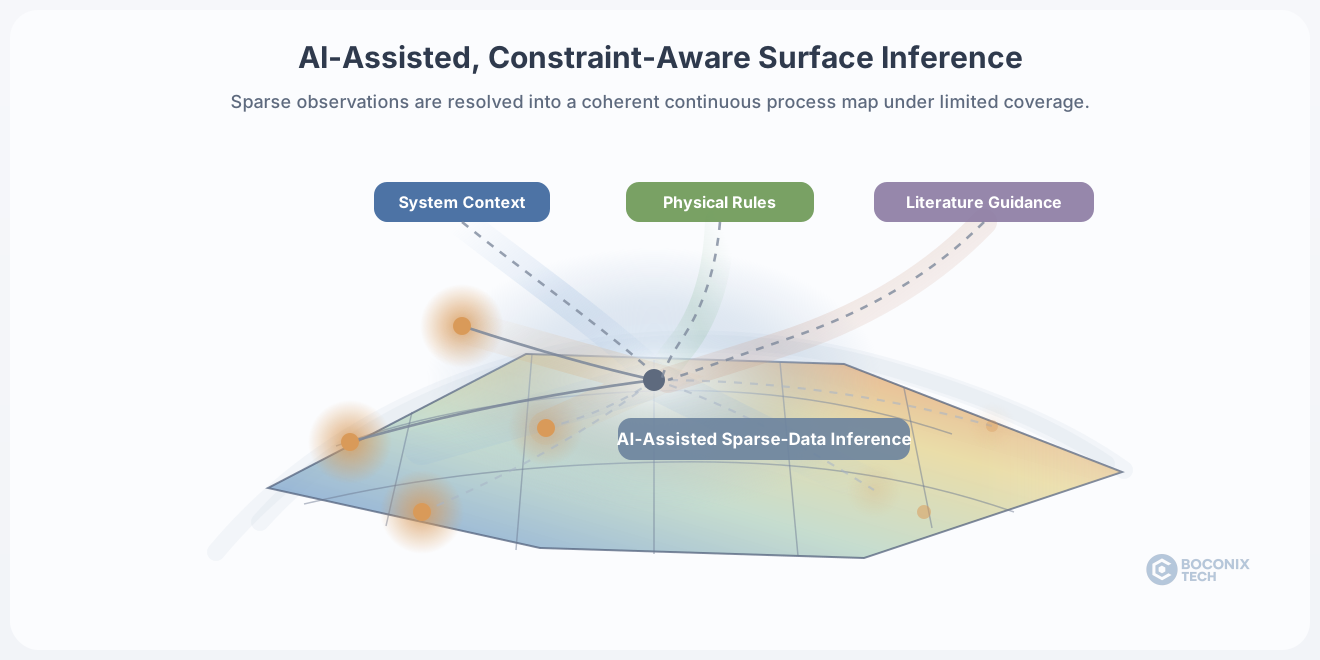
Figure 3. AI-assisted sparse-data inference turns limited observations into a continuous process map, while system context, physical rules, and literature guidance help keep the interpretation coherent under limited coverage.
Why Sparse Models Become Difficult to Read
Sparse experimental datasets rarely define a process map uniquely.
With only a limited number of measured runs, several different map interpretations may appear visually reasonable even when they imply very different engineering conclusions. Small datasets can therefore produce surfaces that look overly sensitive, inconsistent, or difficult to interpret with confidence.
This is especially common when:
- sampling is uneven across variables
- measurements contain noise
- only part of the observed behavior has been captured
- the process is already known to follow practical tendencies that the raw data alone cannot fully reveal
In these situations, the difficulty is not only fitting a surface. It is deciding which of several numerically plausible surfaces deserves to be treated as the more credible process-map interpretation.
How AI-Assisted, Constraint-Aware Modeling Works
Caldera addresses this problem through AI-assisted, constraint-aware modeling. The modeling core performs AI-assisted sparse-data inference, turning limited observations into a continuous process map. Constraint-aware inputs guide that inference across the map, with the greatest effect where sparse evidence leaves more room for ambiguity.
As the core of this modeling approach, Caldera infers a continuous process map from a limited number of measured runs by estimating local response behavior around observed conditions, propagating those local signals into nearby regions of the parameter space, and reconciling overlapping evidence into a surface that remains continuous across the explored domain while staying anchored to the measured data. In practical terms, the model is not simply drawing straight connections between isolated points or filling gaps with arbitrary interpolation. It is inferring how response behavior is likely to continue across neighboring parameter combinations so the resulting map captures a coherent process-space interpretation rather than a mechanical patchwork of sampled values.
Constraint-aware inputs help shape interpretation across the map, not only in the weakest-data regions. They frame what kinds of local continuation remain reasonable across the modeled domain. Their influence becomes most important where sparse observations alone leave several plausible surfaces on the table, because that is where ambiguity is highest and purely numerical fitting is most likely to over-read isolated points, uneven coverage, or fragile local structure.
In the current product, that additional structure comes primarily from three sources:
- system context
- physical rules
- literature guidance
System context frames what process is being modeled and what the variables mean in that setting. Physical rules help exclude interpretations that may be numerically possible but difficult to justify from an engineering standpoint. Literature guidance adds domain-informed expectations from documented process behavior in related systems. Together, these inputs help define which local continuations of the sparse evidence remain reasonable to consider when the data alone cannot fully resolve the surface.
Constraint-aware modeling does not replace the modeling core. It adds guided boundaries around the inference step so sparse observations can be turned into a continuous map that remains more coherent and more defensible under limited coverage.
Using Prior Knowledge Without Overriding Data
Constraint-aware modeling only works if prior knowledge remains in the right role.
Measured observations should remain the primary evidence wherever local support is strong and internally consistent. If the observed runs already establish a clear local pattern, the inferred map should continue to follow that evidence rather than forcing it back toward a preferred expectation. Prior knowledge still helps frame interpretation across the map, but it becomes most consequential where the data leave more room for ambiguity. Prior knowledge becomes most useful where evidence is weak, noisy, or locally ambiguous, because those are the regions where sparse data are most likely to produce unstable features that look more definitive than they really are.
This distinction matters because sparse datasets can easily create apparent ridges, turns, or pockets from a small cluster of runs, an isolated high-value point, or uneven sampling across variables. Without guided interpretation, those local features can make sparse-data maps look more irregular, more sensitive, or more certain than the underlying evidence actually supports.
System context, physical rules, and literature guidance help stabilize those ambiguous regions without taking control away from the data. They help the model stay aligned with practical engineering understanding where sparse evidence leaves too much room for over-interpretation. But where measured support is strong, observed data should continue to anchor the map. In that sense, prior knowledge does not replace measurements; it guides interpretation where evidence is limited while preserving the role of data wherever local support is clear.
Why This Matters in Practice
For engineering teams, the value of AI-assisted, constraint-aware modeling is practical rather than abstract.
It helps produce process maps that are:
- easier to interpret under limited sampling
- less likely to be dominated by isolated irregular points
- more consistent with known process behavior
- more useful for screening candidate regions and planning follow-up experiments
Caldera is therefore not only about prediction. It is about producing a process-map representation that better supports engineering judgment when data remain limited.
Summary
Sparse experimental data often leave room for several possible map interpretations.
Caldera addresses this by combining sparse-data inference with AI-assisted, constraint-aware modeling, using system context, physical rules, and literature guidance to keep process maps more coherent under limited coverage.
This perspective helps teams:
- reduce unstable or implausible map reading
- interpret sparse datasets more reliably
- use prior knowledge as guidance without overriding measured observations