
Caldera Technical Note #05
AI-Enabled Response-Specific Next-Run Recommendations
Exploration, exploitation, and extrapolation for each selected response within the chosen process space, supported by AI-assisted interpretation.
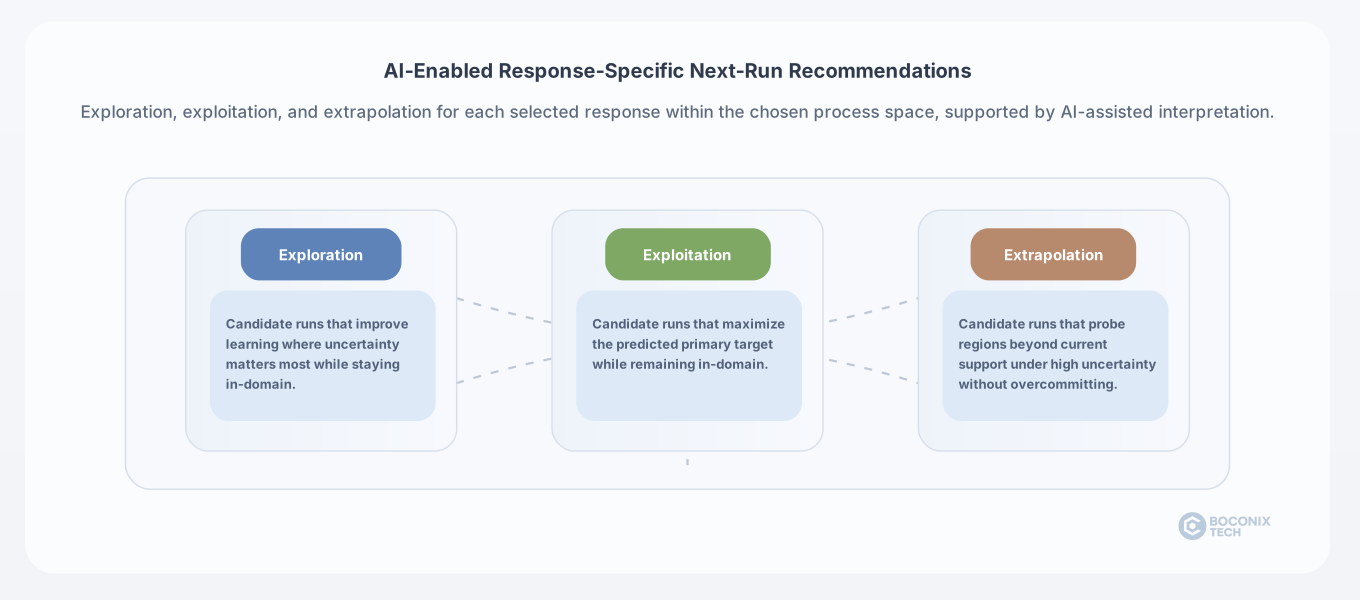
Figure 5. AI-assisted process-map interpretation can show why different next-step modes can coexist for the same response under limited coverage.
Why Multiple Next-Run Recommendation Modes Are Needed for One Response
A single response map can still call for multiple next-run modes.
Even for one response, the process space does not answer just one planning question. Some regions still need more learning. Some already support a strong move. Others only become interesting near the edge of current support.
That is why a single response should not automatically collapse into one generic recommendation. If a map contains uncertain interior structure, better-supported favorable regions, and and out-of-support continuation that may require further confirmation at the same time, then the next-step logic also has to separate.
This matters because recommendation modes are not merely presentation choices. They define what kind of evidence the next run is meant to produce.
Three Recommendation Modes for Each Response
Caldera therefore organizes next-step guidance for a given response around three practical recommendation modes. Technical Note 04 explains what extrapolative regions are and why they require higher caution. In this note, Extrapolation Mode refers to testing which out-of-support points are worth confirming further. The other two modes address when the next run is better used for learning or for acting on a more credible interior direction.
Exploration mode is used when the next run has the highest learning value for improving understanding of that response map. Exploitation mode is used when the current map supports pushing a favorable direction inside better-supported territory. Extrapolation mode is used when a response extends beyond current support and a cautious test is needed to determine whether that continuation requires further confirmation.
These modes should not be read as three confidence levels of the same recommendation. They are three different planning intents. One is about learning more. One is about acting on what already looks usable. One is about testing whether an out-of-support continuation should remain only a boundary signal.
Exploration Mode
Exploration mode matters when uncertainty reduction is more valuable than immediate performance gain.
For a given response, exploration becomes the right mode when additional data would materially improve interpretation. This does not mean the response is unpromising. It means the most useful next run is one that sharpens understanding rather than one that immediately pursues a favorable-looking region.
This is especially important under limited coverage, where some parts of a response map may still remain structurally ambiguous even if other regions already look more settled. In that setting, an exploration run is not a delay. It is the most direct way to improve the quality of later decisions for that same response.
Exploration therefore protects decision quality before performance is pushed too hard. It helps prevent a map from being read as more settled than current evidence can support, and it keeps the next run focused on reducing the uncertainty that most limits useful action.
Exploitation Mode
Exploitation mode becomes appropriate when a response already shows a usable direction inside better-supported territory.
This mode is not simply “go to the highest point.” It is the recommendation mode used when the map suggests that pushing a favorable region is more valuable than spending the next run on further clarification. That is why exploitation remains a practical mode rather than a purely performance-seeking one. It still depends on support, region width, and whether the apparent opportunity is credible enough to justify action now.
For one response, exploitation may already be the clearest next step. For another, the same process space may still be too uncertain for exploitation to be the right call. The important point is that exploitation belongs to responses that are ready for a stronger move, not simply to responses that contain a bright-looking point.
This also means exploitation should be understood as a controlled advance, not as a claim of final optimality. It is the mode used when current evidence is already strong enough to justify acting on a promising direction, while still recognizing that later runs may refine where that direction ultimately leads.
Extrapolation Mode
Extrapolation mode is used to check whether an out-of-support continuation should remain only a boundary signal or become part of the working decision frame.
Some responses become most uncertain near the edge of current support. A boundary region may still suggest a continuation worth examining, but it cannot be treated the same way as a better-supported interior recommendation. It carries higher uncertainty and weaker support, even when it may still affect the next decision.
This is why extrapolation is a distinct recommendation mode rather than a more aggressive form of exploitation. Its role is not to assume that an edge signal is already established. Its role is to test whether that signal holds strongly enough to warrant further consideration.
Used well, extrapolation keeps boundary continuation visible without pretending that boundary evidence is already secure. It gives the map a way to represent cautious extension as its own planning intent rather than forcing every out-of-support signal into either exploration or exploitation.
Why This Matters Before Cross-Target Trade-offs
Response-specific recommendation modes create the right starting point for later multi-target trade-off decisions.
Before several targets are weighed together, it is important to see what each response is actually asking for on its own map. One response may still need exploration, another may already justify exploitation, and a third may only justify cautious extrapolation. More importantly, different responses may favor different regions, tolerate different levels of uncertainty, and attach value to different kinds of improvement. Those differences are not just differences in recommendation mode. They are the trade-off structure that later multi-target decisions must reconcile.
That is why a single blended recommendation is not enough. Trade-off decision-making is not only about combining different recommendation modes across responses. It is about deciding how competing objectives should be balanced when progress for one response may require accepting limits, slower gains, or greater caution in another.
The next step is not to flatten these response-specific modes into one generic answer. The next step is to decide how they should be weighed together once several objectives must matter at the same time. That cross-target trade-off layer is the subject of the next note.
Summary
Response-specific recommendation modes make it possible to ask the right next-step question for each response.
Caldera uses AI-assisted process-map interpretation to show whether a response is best approached through exploration, exploitation, or extrapolation, rather than forcing every map-derived decision into one default next move.
This perspective helps:
- explain why one response can justify multiple next-step modes
- keep learning, credible interior action, and cautious out-of-support testing distinct
- make recommendation intent visible rather than hiding it inside one blended answer
- build a clear base for later cross-target trade-off decisions